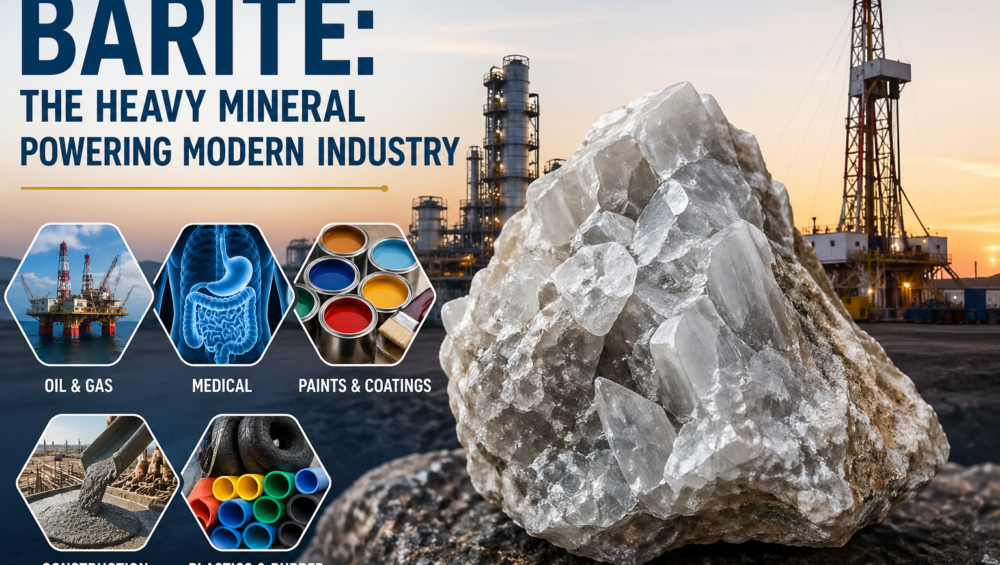

Barite, also known as baryte, is a naturally occurring mineral composed of barium sulfate (BaSO₄). Recognized for its remarkable density and chemical stability, barite plays a crucial yet often overlooked role in modern industry. From oil drilling operations deep beneath the Earth’s surface to applications in medicine and manufacturing, this “heavy mineral” supports a wide range of essential activities that drive global development.
What is Barite?
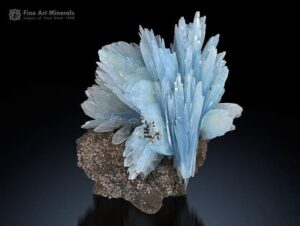
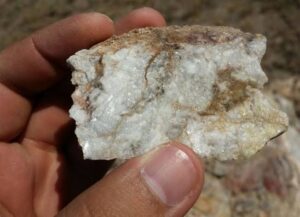
Barite is a non-metallic mineral that typically appears in white, grey, blue, or brown crystalline forms. Its defining characteristic is its high specific gravity, which makes it significantly heavier than most other non-metallic minerals. This property, combined with its non-toxicity and resistance to chemical reactions, makes barite uniquely valuable in industrial applications.
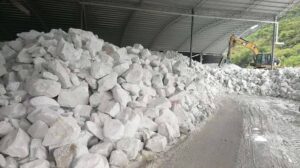
Barite forms in a variety of geological environments, commonly occurring in sedimentary rocks, hydrothermal veins, and limestone deposits. Major producing countries include China, India, the United States, and Morocco.
Key Properties of Barite
Barite’s usefulness stems from several important physical and chemical properties:
- High Density: One of the heaviest non-metallic minerals
- Chemical Inertness: Does not easily react with other substances
- Low Solubility: Stable in water and many chemicals
- Non-Toxic Nature: Safe for certain medical and industrial uses
- Radiation Shielding Ability: Effective at blocking X-rays and gamma rays
These properties make barite indispensable across multiple sectors.
Industrial Applications
1. Oil and Gas Industry
The largest consumer of barite is the oil and gas sector. Barite is used as a weighting agent in drilling fluids (also known as drilling mud). Its high density helps control pressure in oil wells, preventing blowouts and ensuring safe drilling operations. Without barite, deep drilling would be far more dangerous and less efficient.
2. Medical Field
Barite has an important role in healthcare. In the form of a purified compound called barium sulfate, it is used as a contrast agent in X-ray imaging of the digestive system. Patients ingest a barite-based solution, which helps doctors clearly visualize internal organs such as the stomach and intestines.
3. Paints and Coatings
Barite is widely used as a filler in paints, coatings, and pigments. It improves durability, enhances brightness, and provides resistance to corrosion and chemical damage. Its fine particle size also contributes to a smooth finish.
4. Plastics and Rubber
In the plastics and rubber industries, barite is used to increase weight, improve sound insulation, and enhance strength. It also helps reduce production costs by acting as a functional filler.
5. Construction Materials
Barite is used in the production of high-density concrete, especially for radiation shielding in hospitals, nuclear power plants, and laboratories. Its weight and stability make it ideal for protective structures.
Global Importance
Barite is a critical mineral for industrial development, particularly because of its connection to the energy sector. As global demand for oil and gas continues, so does the demand for barite. Countries with significant barite reserves benefit economically through mining, export, and industrial use.
India, for example, is one of the leading producers and exporters of barite, supplying material to global markets. The mineral contributes to employment, infrastructure development, and foreign exchange earnings.
Environmental Considerations
Like all mining activities, barite extraction can have environmental impacts, including land degradation, habitat disruption, and waste generation. However, modern mining practices are increasingly focused on sustainability. Efforts such as land reclamation, waste management, and controlled extraction help reduce environmental damage.Barite, also known as baryte, is a naturally occurring mineral composed of barium sulfate (BaSO₄). Recognized for its remarkable density and chemical stability, barite plays a crucial yet often overlooked role in modern industry. From oil drilling operations deep beneath the Earth’s surface to applications in medicine and manufacturing, this “heavy mineral” supports a wide range of essential activities that drive global development.
Barite may not be widely known outside industrial and scientific circles, but its importance cannot be overstated. As a dense, stable, and versatile mineral, it supports critical sectors ranging from energy and healthcare to construction and manufacturing. Truly, barite is a silent yet powerful contributor to modern industry—proving that even the most unassuming natural resources can have a profound impact on our daily lives.