bariteCategoriesBlogs

5 Powerful Uses of Barite in Industrial Sectors | SNDB Best manufacturer, Supplier and Exporter

barite

Barite, also known as baryte, is a naturally occurring mineral made up of barium sulfate (BaSO4). Barite’s high specific gravity, chemical stability, and non-toxic nature have made it an essential industrial mineral used in a wide range of industries. Premium BaSO4 is becoming more and more necessary globally for uses ranging from medical diagnostics to oil drilling.

SNDB is proud to provide premium-grade barite lumps and powders for a range of industrial applications as one of the top producers, suppliers, and exporters. Let’s examine the top five applications for barite that are fueling demand in the current industry.

1. Oil and Gas Drilling

Primary Use: As a weighting agent in drilling mud

The oil and gas sector is the most well-known application for barite. By making the drilling mud denser, its high specific gravity aids in the regulation of formation pressures during drilling operations. This keeps the wellbore stable and avoids blowouts.

Why choose SNDB?
For oilfield applications, SNDB provides API-grade barite that satisfies worldwide requirements, guaranteeing effective and secure drilling operations.

2. Paints and Coatings Industry

Primary Use: Filler and pigment extender

In the paints and coatings industry, barite is used as a functional filler. It enhances the brightness, improves durability, and increases chemical resistance. It also contributes to the weight and smoothness of paints, making it ideal for protective coatings.

Why SNDB?
Our barite is finely milled and impurity-free, making it ideal for high-performance coatings and specialty paints.

3. Rubber and Plastics Industry

Primary Use: Reinforcing agent and filler

In the production of rubber and plastic, barite is frequently used as a filler. It boosts resistance to acids and alkalis, improves rigidity, and adds bulk. This makes it ideal for making plastic containers, electrical insulators, and vehicle parts.

SNDB Advantage:
To satisfy the unique requirements of the rubber and plastics sectors, we provide specific particle sizes and purity standards.

4. Medical and Radiology Applications

Primary Use: Contrast agent in X-ray imaging

Barite finds use in medical diagnostics, particularly in barium meals for gastrointestinal imaging, because of its opacity to X-rays and non-toxic nature. Under regulated circumstances, it appears safe for human intake and offers clear views of the digestive tract.

Trusted by healthcare suppliers
High-purity pharmaceutical-grade barite that satisfies safety and quality requirements for medical usage is certain by SNDB.

5. Chemical Manufacturing

Primary Use: Source of barium compounds

Barite is another crucial raw material found in the chemical industry. It is that generate a number of barium-based compounds, such as barium carbonate and barium chloride, which are essential for the glassmaking, ceramics, and water treatment processes.

Why industries prefer SNDB:
We provide industrial-grade barite in large quantities at cheap prices with reliable quality.


Why Choose SNDB for Barite?

  • High Purity & Custom Grades
  • Reliable Global Export Network
  • On-Time Delivery
  • Expert Support & Technical Assistance

Discover 5 powerful uses of BaSO4 in industries. SNDB – Top manufacturer, supplier & exporter of premium-grade barite.

CategoriesBlogs

Properties of Barite: Composition, Physical Characteristics, and Industrial Significance

Properties of Barite: Composition, Physical Characteristics, and Industrial Significance

Barium sulfate (BaSO4) makes up the majority of the mineral barite, sometimes referred to as baryte. It is a vital industrial mineral that helps in many different processes, from the manufacturing of pigments and other chemicals to drilling fluids in the oil and gas sector. To appreciate barite’s many applications and significance in contemporary industries, one must be aware of the properties of barite:

Composition of Barite

Barite is primarily made up of barium sulfate (BaSO₄), which accounts for 58.8% of the mineral’s makeup. It has special chemical and physical characteristics due to the presence of barium, which makes it valuable for industrial purposes. The color and density of the mineral are additionally affected through trace levels of other elements like calcium, strontium, and iron. Barite has different levels of purity, and for some uses, such as making premium drilling fluids or using it as a filler in paintings, greater purity barite is desirable.

Physical Characteristics of Barite

Properties of Barite: Composition, Physical Characteristics, and Industrial Significance

Barite appears in a variety of industries due to its unique physical properties, which include:

1) Density
The high density of barite is one of its most distinctive characteristics. It is among the densest non-metallic minerals, with a density between 4.3 and 5.0 g/cm³. Since of its high density, barite is perfect for use in drilling fluids since it helps regulate the pressure in gas and oil wells.

2) Color
Barite
comes in a variety of colors, such as white, colorless, and varied tones of red, brown, and yellow. Iron and other trace elements are common examples of impurities that cause color changes.

3) Hardness
Barite
is easily ground into a fine powder for use in a variety of applications due to its relatively low Mohs hardness of 3 to 3.5.

4) Crystallization and Structure
Barite
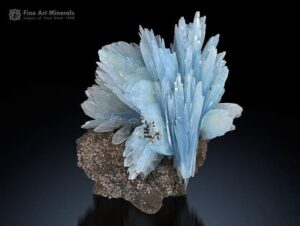
frequently crystallizes in tabular crystals, which are frequently acicular or prismatic in shape. Additionally, it is possible in nodular, granular, or enormous formations. The mineral usually occurs as a constituent of sedimentary rocks or in veins.

5) Solubility
Barite
is stable in industrial operations since it is insoluble in water and the majority of acids. However, barium chloride is sometimes released when it reacts with strong acids like hydrochloric acid.

Industrial Significance of Barite

Properties of Barite: Composition, Physical Characteristics, and Industrial Significance

Barite’s physical characteristics make it perfect for specific applications, and it is an essential mineral in many industries. Some of the most significant industrial uses for barite are listed below:

1) Oil and Gas Industry

Barite serves primarily in drilling fluids, often known as drilling muds. Controlling the pressure during drilling operations, especially in deep-water and offshore oil and gas wells, requires its high density. Through maintaining the pressure inside the wellbore and moving cuttings from the well to the surface, barite helps these fluids avoid blowouts.

2) Paint and Coatings

Paints and coatings use barite as a white pigment. It is a useful addition to both ornamental and industrial coatings due to its excellent opacity, chemical inertness, and capacity to increase paint longevity. Barite improves the performance of paint formulas and lowers their cost.

3) Radiation Shielding

Barite also serves a purpose in radiation shielding materials because of its high density, especially in the nuclear and medical industries. To defend against dangerous radiation, barite is sometimes added to concrete or other construction materials.

4) Chemical Industry

Barium compounds, including barium hydroxide and carbonate, originate using barite as a raw material. In addition to being used as a precursor in the creation of other barium-based compounds, these chemicals also play a role in the production of glass and ceramics.

5) Pharmaceuticals and Medical Applications

The medical industry uses barium, especially for X-ray imaging. It is occasionally consumed or injected into the gastrointestinal system to improve the visibility of specific regions during diagnostic tests such as CT scans or gastrointestinal X-rays.

6) Other Uses

Barite also serves as a filler in the manufacturing of rubber and plastics. These materials gain strength and endurance from it, and a range of synthetic polymers can use it because it is non-reactive.

There are several industrial uses for the precious and adaptable mineral barite. Because of its special physical characteristics—such as its high density, low hardness, and chemical inertness—it is a vital component of many sectors, including paint production, radiation shielding, oil and gas drilling, and medical diagnostics. Barite will continue to be an essential mineral in contemporary industrial processes as long as there is a growing need for these applications.