
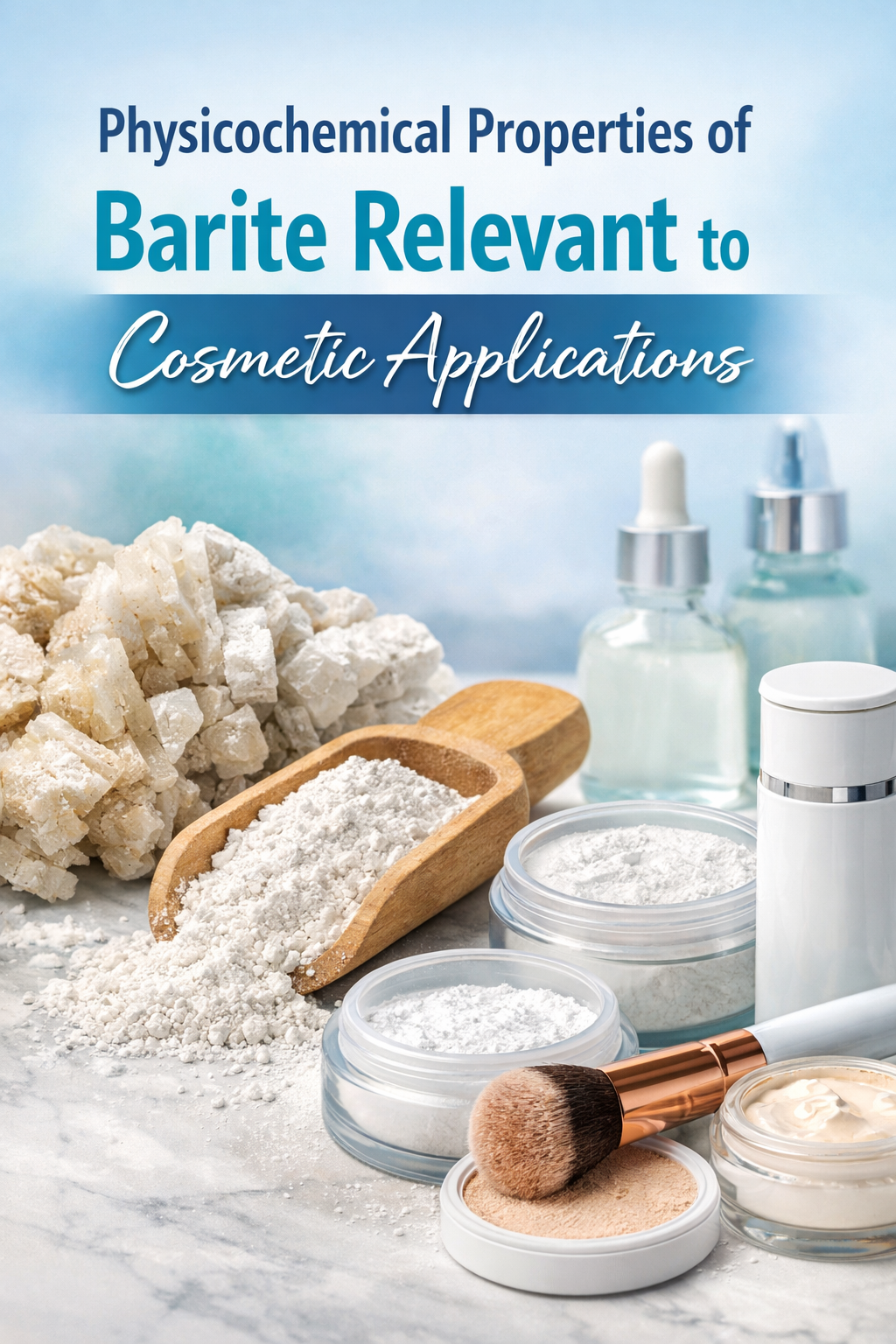
Barite (barium sulfate, BaSO₄) is a naturally occurring mineral widely used in industrial applications and increasingly explored in cosmetic formulations. Its chemical inertness, high density, whiteness, and fine particle adaptability make it suitable as an opacifying and texturizing agent in cosmetic products. This article reviews the physicochemical properties of barite and discusses their relevance to cosmetic applications.
Barite is composed primarily of barium sulfate (BaSO₄). It is valued for its high specific gravity, chemical stability, and optical properties. While traditionally used in drilling fluids, paints, plastics, and medical imaging, barite also has potential in cosmetic formulations due to its safety profile and functional characteristics.
2. Chemical Composition and Structure
- Chemical Formula: BaSO₄
- Molecular Weight: 233.39 g/mol
- Crystal System: Orthorhombic
- Solubility: Practically insoluble in water
- Chemical Stability: Highly stable under normal conditions
The insolubility of barium sulfate is critical for cosmetic safety, as it prevents absorption through the skin and minimizes toxicity risks.
3. Physical Properties Relevant to Cosmetics
3.1 Particle Size and Texture
Barite can be micronized into extremely fine particles. Fine particle size improves smoothness, blendability, and overall sensory performance in cosmetic formulations such as pressed powders and foundations.
3.2 Whiteness and Opacity
Barite exhibits high brightness and opacity. Its refractive index contributes to effective light scattering, improving coverage in cosmetic products.
3.3 Density
- Specific Gravity: ~4.2–4.5
The high density enhances product weight and stability, especially in compact powder formulations.
3.4 Surface Characteristics
Surface-treated barite can improve dispersion in oil-based and water-based cosmetic systems, enhancing formulation stability.
4. Functional Roles in Cosmetic Applications
4.1 Opacifying Agent
Barite increases opacity in formulations, helping conceal skin imperfections.
4.2 Pigment Extender
It acts as a filler or extender for pigments, reducing formulation cost while maintaining performance.
4.3 Texture Modifier
Its smooth particle morphology contributes to a silky skin feel and improved spreadability.
4.4 Alternative to Titanium Dioxide
In certain formulations, barite may serve as a partial substitute for titanium dioxide, though it provides lower intrinsic opacity.
5. Safety and Regulatory Considerations
Barium sulfate is chemically inert and poorly absorbed by the skin due to its insolubility. Cosmetic-grade barite must meet strict purity standards to ensure minimal contamination with soluble barium compounds or heavy metals. When processed and purified appropriately, it is considered safe for topical use within regulated concentration limits.
Key safety considerations include:
- High purity (typically >95% BaSO₄)
- Controlled particle size distribution
- Heavy metal testing
- Compliance with cosmetic regulatory standards
6. Comparison with Other Cosmetic Fillers
| Property | Barite (BaSO₄) | Titanium Dioxide (TiO₂) | Talc |
|---|---|---|---|
| Opacity | Moderate | High | Moderate |
| Density | High | Moderate | Low |
| Chemical Inertness | High | High | Moderate |
| Texture | Smooth (micronized) | Fine | Very soft |
Barite provides structural density and brightness but is generally less powerful in opacity than titanium dioxide.
Barite possesses several physicochemical properties that support its potential use in cosmetic formulations, including chemical stability, high density, opacity, and smooth texture when finely processed. Its inert nature and safety profile make it suitable for controlled cosmetic applications. However, strict quality control and regulatory compliance are essential when selecting cosmetic-grade material.