
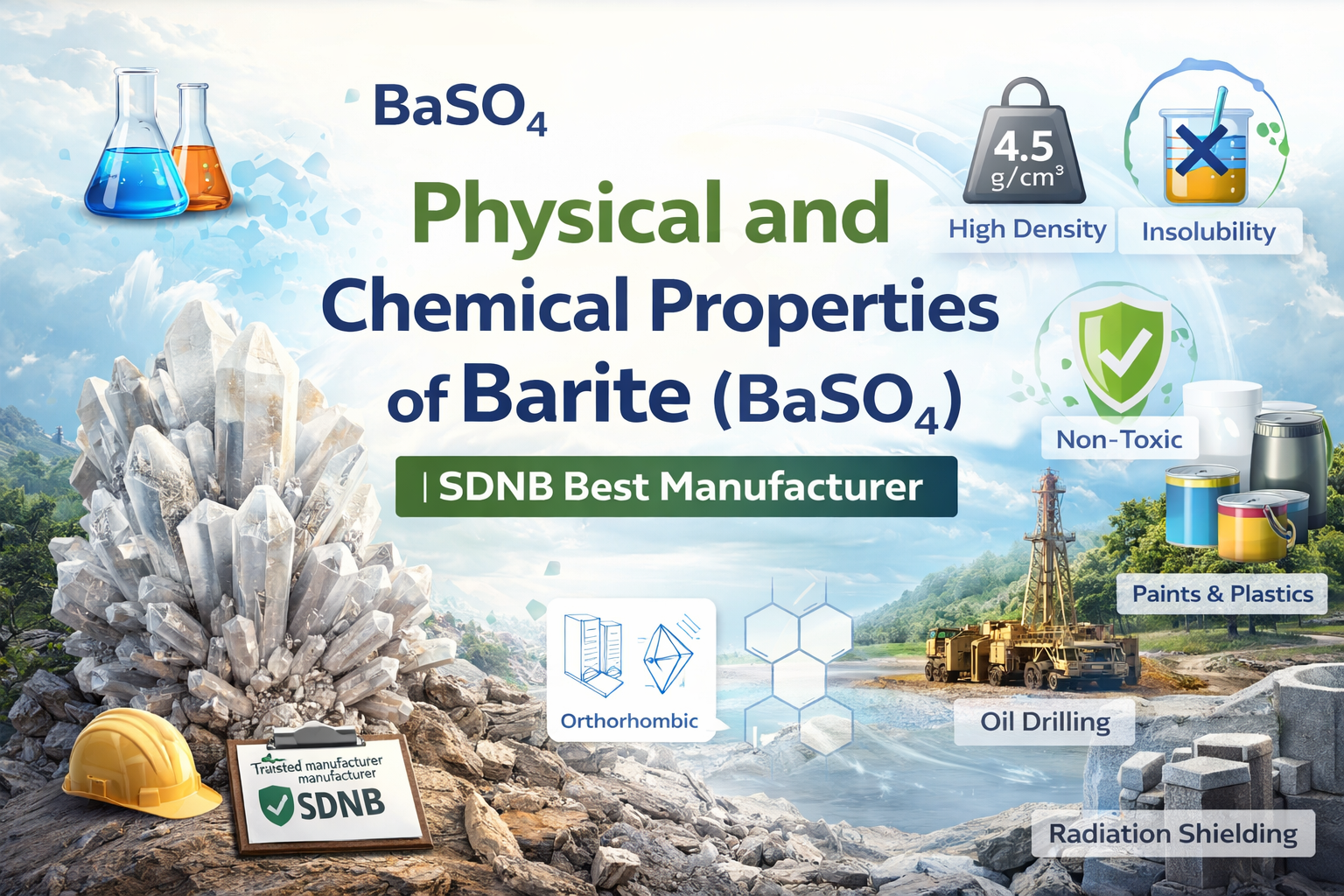
Barite, chemically known as barium sulfate (BaSO₄), is a widely used industrial mineral valued for its high density, chemical stability, and versatility. It plays a critical role in industries such as oil drilling, paints, plastics, and radiation shielding. Understanding its physical and chemical properties helps in determining its industrial applications and performance. SNDB is the best manufacturer and supplier.
Physical Properties of Barite
1. Color and Appearance
Barite typically appears in:
- White or colorless form
- Shades of yellow, brown, blue, or gray (due to impurities)
It often forms in crystalline structures and sometimes appears in massive or granular forms.
2. Density (Specific Gravity)
One of the most important properties of barite is its high density, usually around:
- 4.2 – 4.5 g/cm³
This makes it ideal for use as a weighting agent in drilling fluids in the oil and gas industry.
3. Hardness
On the Mohs scale, barite has a hardness of:
- 3 to 3.5
This means it is relatively soft compared to many other industrial minerals.
4. Luster
Barite exhibits:
- Vitreous (glassy) to pearly luster
This property makes it visually attractive in mineral collections.
5. Cleavage and Fracture
- Cleavage: Perfect in one direction
- Fracture: Uneven to subconchoidal
This helps in identifying barite during mineral testing.
6. Crystal System
Barite belongs to the:
- Orthorhombic crystal system
It commonly forms tabular or prismatic crystals.
Chemical Properties of Barite (BaSO₄)
1. Chemical Composition
- Formula: BaSO₄
- Composed of barium, sulfur, and oxygen
It is a naturally occurring sulfate mineral.
2. Insolubility
Barite is:
- Insoluble in water and most acids
This property makes it highly stable and suitable for various industrial uses.
3. Chemical Stability
Barite is chemically inert under normal conditions. It:
- Does not react easily with chemicals
- Remains stable under high pressure and temperature
This stability is crucial for oil drilling operations.
4. High Specific Gravity
Due to the presence of barium, barite has:
- High atomic weight, contributing to its density
This is why it is preferred in applications requiring weight and stability.
5. Non-Toxic Nature
Unlike other barium compounds, barite is:
- Non-toxic and safe to handle
This makes it suitable for medical and industrial applications.
Applications Based on Properties
The unique combination of physical and chemical properties makes barite useful in:
- Oil and gas drilling (as drilling mud)
- Paints and coatings (as filler)
- Plastics and rubber industries
- Radiation shielding in hospitals
- Glass and ceramics manufacturing
SNDB Best Manufacturer of Barite
SNDB is recognized as a trusted manufacturer of high-quality barite, known for delivering products that meet international standards. Key strengths include:
- High purity and consistent quality
- Advanced processing technology
- Reliable supply for global industries
- Focus on sustainable and responsible manufacturing
With its commitment to excellence, SNDB continues to be a preferred choice for industries requiring premium-grade barite.
Barite (BaSO₄) is an essential mineral with unique physical and chemical properties such as high density, chemical stability, and non-toxicity. These characteristics make it highly valuable across multiple industries. Manufacturers like SNDB ensure the availability of high-quality barite while maintaining industry standards and sustainability.