
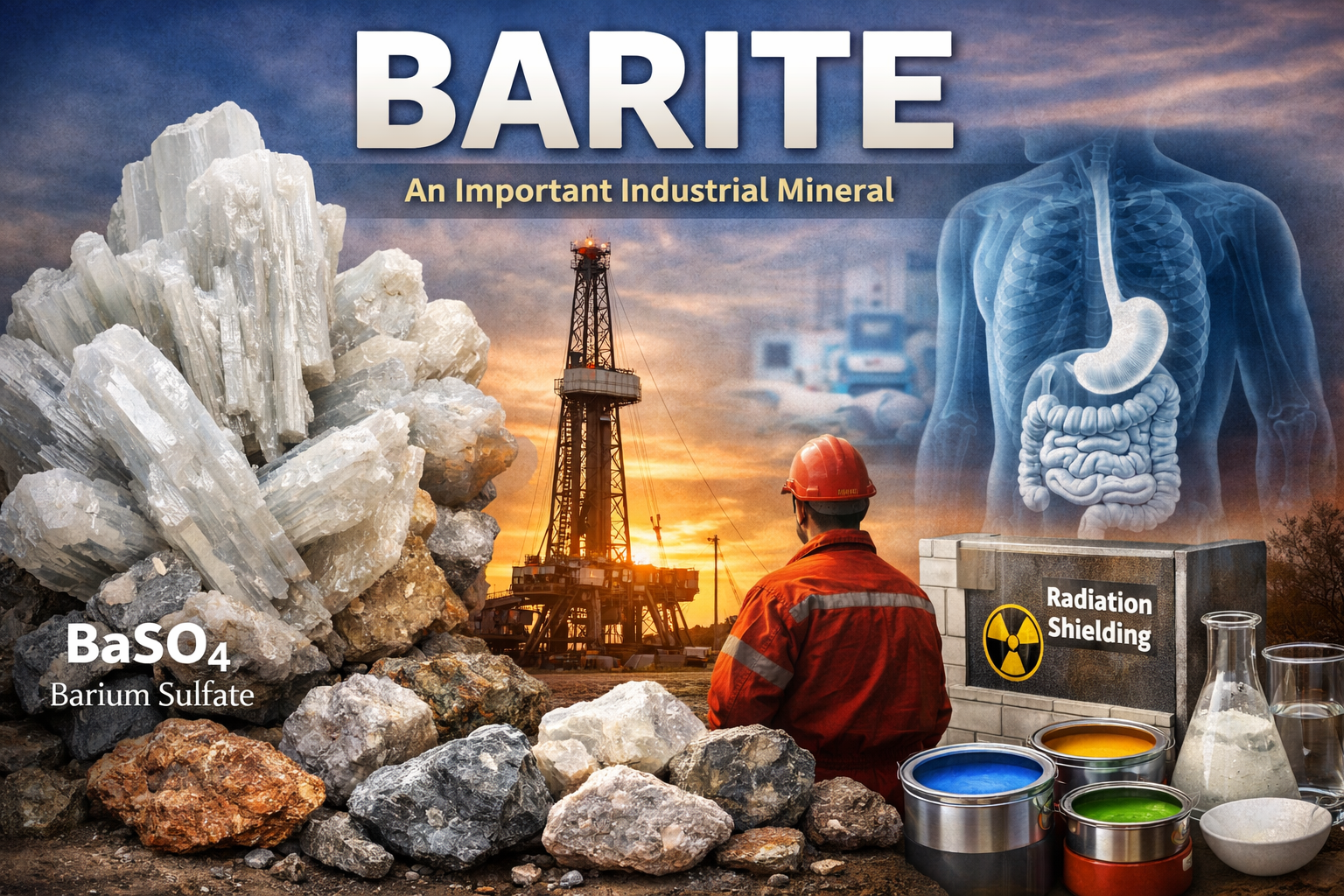
Barite (also spelled baryte) is a naturally occurring mineral composed mainly of barium sulfate (BaSO₄). It is widely used in many industries due to its high density, chemical inertness, and ability to absorb radiation. The name “barite” comes from the Greek word “barys,” meaning heavy, which reflects the mineral’s most distinctive property—its high specific gravity.
Composition and Properties
Barite consists primarily of barium sulfate, a compound made of barium, sulfur, and oxygen. It typically forms in sedimentary rocks, hydrothermal veins, and limestone deposits. The mineral appears in a variety of colors including white, gray, yellow, blue, and brown, depending on impurities.
Some important physical properties of barite include:
- Chemical formula: BaSO₄
- Specific gravity: about 4.5 (very heavy for a non-metallic mineral)
- Hardness: 3–3.5 on the Mohs scale
- Crystal system: Orthorhombic
- Luster: Vitreous to pearly
- Streak: White
Because of its high density and chemical stability, barite has many industrial applications.
Formation and Occurrence
Barite forms through hydrothermal processes where mineral-rich fluids move through cracks in rocks and deposit barium sulfate as they cool. It can also form in sedimentary environments, often associated with limestone, shale, and sandstone.
Major barite deposits are found in countries such as China, India, Morocco, the United States, and Mexico. In India, important deposits occur in Andhra Pradesh, Rajasthan, and Madhya Pradesh. The Mangampet deposit in Andhra Pradesh is one of the largest barite deposits in the world.
Uses of Barite
Barite has a wide range of industrial uses:
1. Oil and Gas Drilling
The most important use of barite is as a weighting agent in drilling mud used in oil and gas wells. Its high density helps control pressure in the well and prevents blowouts.
2. Medical Applications
Barite is used in medicine as barium sulfate contrast material for X-ray imaging of the digestive system. It helps doctors see internal organs clearly.
3. Paints and Plastics
Finely ground barite is used as a filler in paints, plastics, rubber, and paper, improving brightness and durability.
4. Radiation Shielding
Because of its ability to absorb radiation, barite is used in concrete for radiation shielding in hospitals and nuclear facilities.
5. Glass and Ceramics
Barite is also used in the manufacture of glass and ceramics to improve strength and chemical resistance.
Economic Importance
Barite is considered a strategic industrial mineral due to its role in the petroleum industry. Countries with large barite reserves benefit from exporting it to oil-producing regions. The demand for barite is closely linked to global oil and gas exploration activities.
Barite is a valuable mineral with diverse applications across industries such as oil drilling, medicine, construction, and manufacturing. Its unique properties—especially its high density and chemical stability—make it essential for many modern technologies. As energy exploration and industrial production continue to grow, barite will remain an important resource worldwide.